

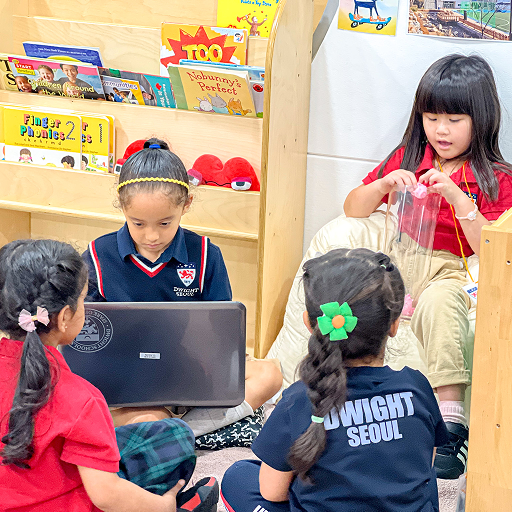
Research and reflection sit at the heart of the IB Middle Years Program (IB MYP), shaping the way students engage with the world and empowering them to become thoughtful, independent learners. These two skill sets are not merely academic exercises; they are lifelong competencies that guide students to ask meaningful questions, analyze information critically, and evaluate their own growth with honesty and intention. In some cases, these skills are also introduced during a child’s early years program. Within the IB continuum, the ability to research effectively and reflect deeply ensures that students not only absorb knowledge but also understand themselves as learners. At Dwight Seoul, these skills are woven into everyday learning, reinforcing our commitment to nurturing curious, compassionate, and capable global citizens.
Understanding how research and reflection take shape across the IB ensures families see the continuity between the Early Years Programme, the IB Middle Years Program, and ultimately the International Baccalaureate Diploma Programme (IB DP). The habits introduced in the Early Years—such as inquiry, observation, and self-awareness—become structured and intentional in the MYP, setting the stage for the rigorous, self-directed research expectations of the Diploma Programme. For this reason, developing research skills in MYP students and cultivating the power of reflection are essential steps in ensuring a smooth and confident transition across all stages of IB learning.
At Dwight Seoul, students are encouraged to lead their own learning journeys. By engaging deeply in inquiry, asking their own questions, and reflecting on both their achievements and challenges, they learn to take ownership of their academic pathways. This nurturing environment helps them develop the academic courage and personal insight needed not only for success in the MYP, but also for the IB Diploma and the world beyond.
Why Research Skills Matter in the MYP
Research skills in MYP students form the foundation of how they make sense of complex ideas in an ever-changing world. In the IB Middle Years Program, research is about more than gathering information. It teaches students to approach learning with curiosity and responsibility, to verify sources, and to build arguments that are thoughtful and balanced. Through research, students learn to navigate diverse perspectives and understand that knowledge is constructed, not simply received.
The importance of research in the MYP becomes even clearer when connected to the broader IB continuum. Early Years learners begin as natural inquirers, developing confidence in asking questions about the world around them. As they enter the Middle Years, this curiosity evolves into structured research within the IB MYP framework, preparing them for the academically rigorous and independent nature of the IB Diploma Programme. When students develop strong research habits early, they build the confidence needed for Extended Essays, internal assessments, and the self-directed expectations of higher education.
These competencies take shape in real examples across classrooms. A science investigation allows students to gather data and evaluate results. A humanities project challenges them to explore historical evidence from multiple sources. Even within arts classes, students often research cultural movements or artistic techniques before creating original work. Each example strengthens their ability to seek information ethically and apply it meaningfully.
How to Develop Research Skills in IB Curriculum
Research skills in the IB curriculum are carefully scaffolded so students can gradually take on greater responsibility and intellectual challenge. The MYP framework introduces research explicitly through inquiry-based units, subject-specific investigations, and interdisciplinary assignments that mirror real-world problem-solving. Students learn not only how to locate information but also how to analyze, interpret, and present it clearly.
This scaffolding is essential for student growth across the entire IB journey. Within the MYP, strong research habits help students refine their thinking, organize their ideas, and take ownership of their learning. These competencies directly support success in the IB Diploma Programme, where research becomes even more demanding and self-directed. When students build confidence and independence in research early, they are better prepared for DP requirements such as the Extended Essay and Theory of Knowledge assessments.
Dwight Seoul’s learning environment offers many examples of how research skills develop naturally. Students conduct interviews, analyze data, evaluate media, and use digital tools responsibly. They learn to collaborate with peers, seek feedback from teachers, and pursue areas of personal interest. Through these daily experiences, research becomes not an isolated academic task, but a meaningful part of how students engage with the world.
Understanding the Power of Reflection
Reflection in the IB MYP invites students to pause, consider their choices, and understand their growth. It develops self-awareness, emotional intelligence, and the ability to set intentional goals. When students reflect, they evaluate what they have learned, how they have learned it, and how they can improve. Reflection transforms learning from a passive process into an active and deeply personal journey.
The connection to the broader IB continuum is significant. The Early Years Programme introduces reflection through simple yet powerful tools—sharing circles, learning journals, and teacher-guided discussions. In the MYP, reflection becomes more structured, helping students articulate their strengths and areas for development. This reflective mindset becomes essential in the IB Diploma Programme, where students must justify their research choices, reflect on their approaches to learning, and think critically about their own perspectives.
Examples of reflection are woven into learning across Dwight Seoul. Students may write in learning journals after completing a project, engage in teacher-guided conferences, or participate in peer feedback sessions. They reflect on challenges they faced and strategies they used to overcome them, helping them build resilience and academic confidence.
Integrating Research and Reflection in MYP Learning
Research and reflection work best when integrated seamlessly into the learning experience. In the MYP, students are taught not only to gather information but also to think about their own thinking, evaluate their progress, and refine their approaches. Integrating these skills ensures students grow into independent thinkers who can understand both the content they are studying and themselves as learners.
This integration strengthens key transitions in the IB continuum. As students move from the structured inquiry of the MYP to the self-directed nature of the IB Diploma, their ability to research thoughtfully and reflect honestly becomes crucial. This prepares them for academic challenges, collaborative work, and the intellectual independence needed beyond school.
Examples at Dwight Seoul include interdisciplinary projects where students research complex issues and reflect on the process, personal learning conferences, and unit reflections where students identify new strategies to improve future work. These integrated experiences develop both cognitive and emotional growth.
The Personal Project: A Culmination of Both Skills
The MYP Personal Project is one of the most evident demonstrations of research and reflection coming together. Students choose a topic of personal interest, engage in extensive research, and create an original product that represents their learning journey. The project demands sustained inquiry, perseverance, and the ability to reflect meaningfully on decisions made along the way.
Within the IB continuum, the Personal Project acts as a bridge to the IB Diploma Programme. The independence required to structure research, manage deadlines, and reflect on progress closely mirrors the expectations of the Extended Essay and internal assessments. Students who complete the Personal Project build resilience and confidence that serve them well as they move toward the demands of DP coursework.
Examples of Personal Projects at Dwight Seoul often highlight this balance—students designing apps, composing original music, launching community initiatives, or exploring scientific innovations. Each project demonstrates deep inquiry paired with thoughtful self-evaluation.
Preparing for the IB Diploma and Beyond
The development of strong research and reflection skills in MYP students ultimately prepares them for the IB Diploma and their future academic pathways. In the DP, students must conduct advanced research, evaluate sources critically, and articulate their thinking with clarity. Reflection becomes essential as they navigate complex subjects, manage time, and balance academic and personal growth.
These skills extend far beyond school. Universities and future workplaces value individuals who can analyze information independently, ask meaningful questions, and reflect on their performance to grow continuously. The IB MYP provides an exceptional foundation for these competencies, and Dwight Seoul’s commitment to nurturing independent, critical thinkers ensures students move forward with confidence and purpose.