


The IB Primary Years Programme (PYP) places inquiry at the heart of learning. Rather than teaching subjects in isolation, the PYP uses a transdisciplinary, student-centred approach that encourages children to make meaningful connections across different areas of knowledge. Learning is rooted in responsible action, helping students understand how their knowledge can be applied in real-life situations. This approach makes learning more engaging, relevant, and purposeful while nurturing curiosity and a lifelong love of learning.
At Dwight School Seoul, the PYP is designed to be dynamic, inquiry-led, and concept-driven—helping students grow academically and socially-emotionally while learning to think critically and creatively.
Why inquiry-based learning is central to early education
The IB Primary Years Programme (PYP) places inquiry at the heart of learning. Rather than teaching subjects in isolation, the PYP uses a transdisciplinary, student-centred approach that encourages children to make meaningful connections across different areas of knowledge. Learning is rooted in responsible action, helping students understand how their knowledge can be applied in real-life situations. This approach makes learning more engaging, relevant, and purposeful while nurturing curiosity and a lifelong love of learning.
Inquiry-based learning helps children:
- Build Confidence in Asking and Refining Questions
Children are encouraged to ask thoughtful questions, investigate ideas, and deepen their understanding through exploration and reflection. - Connect Ideas Across Subjects
Students link concepts from reading, mathematics, science, the arts, and other subjects, helping them see how learning applies beyond the classroom. - Strengthen Collaboration and Communication
Through discussions, group activities, and shared inquiry, children learn to work effectively with others, express their ideas clearly, and value different perspectives. - Develop Reflection, Research, and Problem-Solving Skills
Students learn to investigate information, reflect on their learning, analyse challenges, and develop creative solutions—essential skills for lifelong learning and future success.
Statistical Insight: More than 2 million students study IB programmes across 5,900+ IB World Schools in 160+ countries, demonstrating the worldwide adoption of inquiry-based learning through programmes such as the PYP. (Source: https://ibo.org/)
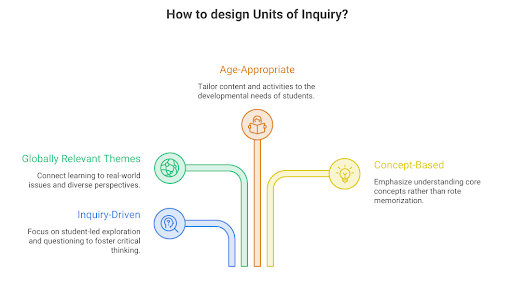
How the PYP curriculum uses Units of Inquiry
In the PYP, learning is organised through a Programme of Inquiry—a year-long map of learning experiences. Schools plan multiple Units of Inquiry (UOIs) under broad themes that are globally relevant and age-appropriate.
At Dwight School Seoul, the PYP for Grades 1–5 includes:
- Grade 1: 5 Units of Inquiry
- Grades 2–5: 6 Units of Inquiry
All aligned to the PYP’s six transdisciplinary themes and integrating six subject areas (including math, science, social studies, language, arts, and physical/social/personal education).
What is a Unit of Inquiry in IB?
A Unit of Inquiry is a planned learning journey where students explore a “big idea” through questions, investigation, and reflection—then apply what they learned in real-world ways.
One helpful way to picture it:
Unit of Inquiry in the IB Primary Years Programme
In the PYP, UOIs aren’t “extra projects.” They are the learning engine that connects classroom experiences to the bigger world.
Dwight’s PYP emphasises:
- Inquiry and concept-based learning over rote memorisation
- Transdisciplinary themes that connect subjects
- Learner Profile growth (students becoming reflective, inquisitive, empathetic, and more)
And because Dwight School Seoul is an IB continuum school (PYP–MYP–DP), students build a consistent approach to learning as they progress through grades.
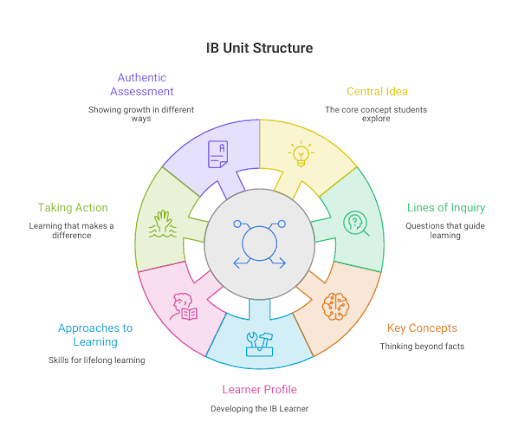
Key elements of the IB PYP Unit of Inquiry
Here’s what typically makes up a strong unit—plus what you’ll likely see as a parent.
| UOI element | What it means | What parents often notice |
| Central idea | The big understanding students build | Kids explaining “the big point” in their own words |
| Lines of inquiry | Sub-questions that guide investigation | Class questions posted, student-led discussions |
| Key concepts | Big thinking lenses (cause, connection, perspective, etc.) | Children making comparisons and “why” explanations |
| Approaches to Learning (ATL) | Skills like research, communication, self-management | More independence, stronger routines, better teamwork |
| Learner Profile | Traits like inquirer, thinker, caring and reflective | Students talking about how they learn, not just what they learn |
| Action | Real steps students take based on learning | Helping others, changing habits, community involvement |
| Assessment | Checkpoints to show growth (often varied and authentic) | Portfolios, reflections, projects, presentations |
Meadowridge summarises the holistic intent well: Units of Inquiry are designed to teach the “whole child”—concepts, skills, attitudes, knowledge, and action.
How Units of Inquiry support concept-based learning
Concept-based learning means students don’t just memorise facts—they learn transferable ideas. For example, a unit might explore systems through ecosystems, human communities, and even simple machines.
Dwight highlights that learning is “driven by key concepts,” helping students transfer understanding from one topic to another—an essential skill for long-term academic success.
Statistical Insight: The same IB well-being study collected responses from 1,639 Year 5 students, 114 teachers, and 56 PYP schools, with findings showing that schools implementing the PYP effectively reported higher student participation, stronger teacher engagement and a more positive school climate. (Source: https://ibo.org/)
Role of UOI in the PYP curriculum
Think of UOIs as the “connective tissue” of the PYP:
- They build global understanding through shared themes (like “Sharing the Planet”).
- They connect subjects naturally, so math and literacy become tools for investigating real questions.
- They shape student agency, because learners aren’t just receiving information—they’re constructing meaning and reflecting on growth.
If you’d like to explore how this connects to Dwight’s approach, see their overview of the primary school curriculum and the broader ib international context.
Conclusion
A Unit of Inquiry in the IB PYP is more than a topic—it’s a structured way for children to become curious thinkers who can connect learning to life. At schools like Dwight School Seoul, students explore multiple units each year through transdisciplinary themes, building skills, concepts, and the confidence to take meaningful action.
FAQs
1) What is a Unit of Inquiry in the IB PYP?
A Unit of Inquiry is a planned, concept-driven learning journey where students investigate big ideas through questions, research, reflection, and action.
2) How many Units of Inquiry are there in the PYP?
It depends on the school. At Dwight School Seoul, Grade 1 explores 5 units and Grades 2–5 explore 6 units per year.
3) What are the six PYP transdisciplinary themes?
Who We Are; Where We Are in Place and Time; How We Express Ourselves; How the World Works; How We Organize Ourselves; Sharing the Planet.
4) Do Units of Inquiry replace subjects like math and English?
No—subjects are still taught, but they’re integrated into the unit so learning connects across disciplines.
5) How are students assessed in a Unit of Inquiry?
Assessment is often varied and authentic (projects, reflections, discussions, portfolios) to show both understanding and skills.
6) Why do parents often hear about the “Learner Profile” in PYP?
Because the PYP aims to develop the whole child—helping students become reflective, caring, and internationally minded, not only academically strong.