

Table of Contents
What is the IB Internal Assessment (IA)? How does it affect IB scores and university admissions?
For parents comparing IB schools, the short answer is this: the IB Internal Assessment is not a minor add-on. In many Diploma Programme subjects, it contributes around 20% to 30% of the final grade, and because school evidence helps inform predicted grades, IA performance can also shape university applications well before final IB results are released.
Executive summary
For families asking what IA in IB is, think of it as the IB’s way of assessing more than exam technique. Internal assessments ask students to investigate, analyse, communicate, and reflect within each subject. In most DP courses, these tasks are completed in school, marked by teachers, and then moderated by the IB to maintain consistency. That means IA rewards steady habits: topic choice, research quality, planning, writing, and revision.
For parents, this matters because IA success is rarely built in a few weeks. It grows from a school culture that values enquiry, close feedback, academic honesty, and personalised support. At Dwight School Seoul, that wider philosophy is visible across the school’s full IB continuum and in its emphasis on personalised learning, community, and global vision.
What is IA in IB?
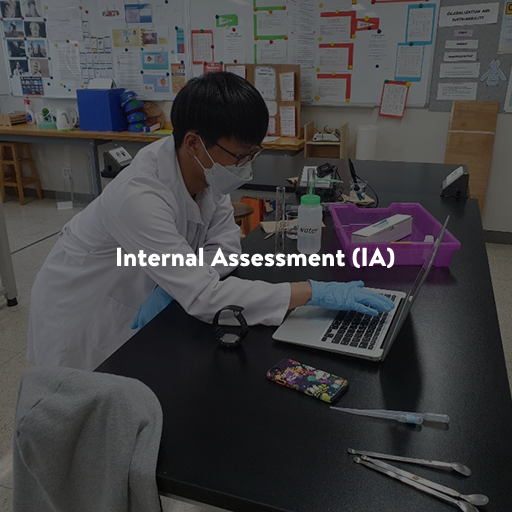
IB Internal Assessment refers to subject-specific coursework completed during the Diploma Programme and assessed against IB criteria. The exact format depends on the subject: it might be a lab investigation, a historical inquiry, a mathematical exploration, or an individual oral. The purpose is to assess skills that timed written examinations cannot fully capture, such as sustained research, independent thinking, and subject-specific application.
So, when parents search IB IA or what is IA in IB Internal Assessment explained, the most accurate answer is this: IA is a formal, weighted part of the final DP grade, not optional coursework and not merely practice for exams.
How IB Internal Assessment works
The IB states that the DP uses both internally and externally assessed components. In most subjects, students complete in-school assessment tasks that are either externally assessed or marked by teachers and then moderated by the IB. In practical terms, teachers guide the process, confirm authenticity, and apply subject criteria, while the IB checks standards through moderation.
This balance is important. Students benefit from teacher support during the learning process, but the final standard is not simply “whatever the school says”. That external moderation is one reason parents often see IA as both rigorous and fair.
IA weightage across IB subjects
IA weightings vary by subject, which is why broad statements such as “IA does not matter much” can be misleading.
Subject | Typical IA component |
Mathematics: Analysis and Approaches | Mathematical exploration — 20% |
Biology / Chemistry / Physics | Scientific investigation — 20% |
History | Historical investigation — 25% at SL, 20% at HL |
Language A: Language and Literature | Individual oral — 30% at SL, 20% at HL |
Language B | Individual oral assessment — 25% |
These representative weightings come from current official IB subject materials and examiner guidance. For families specifically researching IB math IA, the mathematics exploration carries 20% of the final grade in Mathematics: Analysis and Approaches.
How IA impacts final IB scores
Because the IA usually carries meaningful weight, it can either stabilise a student’s performance or place extra pressure on final exams. In subjects where the IA is worth 20%, strong coursework can meaningfully support the final grade; where it rises to 25% or 30%, the effect is even more pronounced. That does not mean IA replaces exam performance, because external assessments still remain a major part of the DP. But it does mean consistent, well-supported coursework can make a measurable difference. This is an evidence-based inference from the official assessment weightings.
For many students, IA also reveals something parents care deeply about: whether a school helps children manage long-term academic work, not just prepare for high-pressure test days.
How IB IA affects university admissions
Strictly speaking, universities do not usually receive a stand-alone “IA score” as an admissions metric. What they often review are predicted grades, school reports, and interim academic evidence. That is where IA matters. Strong IA performance can influence the teacher’s judgement behind predicted grades and can strengthen the overall academic picture presented to universities.
This is not theoretical. UCAS says predicted grades are a key part of the application process. The University of Toronto states that admission consideration is based on predicted or final IB results, and Simon Fraser University requires an IB Predicted Grades Report and notes that an offer of admission is based on predicted grades before final official IB results are reviewed.
For parents aiming at selective admissions pathways, the practical takeaway is simple: the IB internal assessment matters for university admissions not only because it affects subject grades but also because it can shape the evidence universities see first.
What parents should look for in a school’s IA support
When shortlisting schools, ask more than “What were your IB results?” A better question is: how does the school help students through the IB Internal Assessment process?
Look for:
- clear IA timelines and milestone check-ins
- subject teachers who know how to supervise without over-directing
- strong research and academic writing support
- systems for feedback, drafting, and reflection
- university counselling that understands how predicted grades are built
- a culture of inquiry that starts before Grade 11
This is where school fit matters. Dwight Seoul positions itself as the first fully authorised IB Continuum School in Seoul and emphasises personalised learning across ECD, PYP, MYP, and DP. For families entering through preschool admission, that continuum matters: the habits that later support IA success often begin years earlier through inquiry, communication, and guided independence.
Tips to score high in IB Internal Assessment
Students tend to do best when they:
- choose a topic that is narrow, manageable, and genuinely interesting
- start earlier than feels necessary
- understand the assessment criteria before drafting
- prioritise analysis over description
- use feedback well without losing ownership of the work
- leave enough time for referencing, reflection, and revision
In subjects such as IB math IA, topic choice is especially important. A mathematically rich, clearly structured exploration is usually stronger than an over-ambitious idea that never becomes precise.
Common mistakes students make in IB IA
The most common problems are rarely dramatic. They are usually avoidable:
- weak or overly broad topic selection
- too much summary, not enough analysis
- last-minute data collection or rushed drafting
- poor citation habits
- ignoring the rubric until the end
- missing internal school deadlines
For parents, one of the most helpful forms of support is not editing the work, but helping students protect time, stay organised, and ask for help early.
Key takeaways
- IB Internal Assessment is a formal, weighted part of the Diploma Programme, not extra credit.
- In many subjects, IA contributes 20% to 30% of the final mark, so it can materially affect a student’s overall result.
- IA also matters indirectly for admissions because predicted grades remain central in many university processes.
- Parents should look for schools that combine rigour with structure, mentorship, and long-term enquiry development.
- Families comparing an International Baccalaureate programme in Seoul should pay close attention to how a school supports coursework, research, and reflection, not only final exam preparation. Dwight Seoul’s published approach to personalised learning and its full IB continuum make that conversation especially relevant.
Conclusion
The best way to understand IB IA is to see it as a bridge between classroom learning and university-style academic work. It tests whether students can think independently, manage time, investigate deeply, and communicate clearly. Those are exactly the habits families want schools to nurture.
For parents evaluating IB options, IA support is a meaningful lens for judging school quality. A strong school does not simply prepare students for exams; it helps them grow into capable, reflective learners over time. At Dwight Seoul, that idea sits naturally within the school’s broader IB pathway, personalised learning approach, and university-facing academic culture.
FAQs
- What is IA in IB, and why is it important?
An IA is subject-specific coursework completed during the IB Diploma Programme and counted toward the final grade. It matters because it assesses skills such as research, analysis, and communication that exams alone cannot fully measure. - How much does IB internal assessment contribute to final grades?
It varies by subject. Current official examples include 20% in Mathematics: Analysis and Approaches, 20% in sciences, 25% in Language B, and up to 30% in some Language A SL assessment models. - What is IB Math IA?
The IB maths IA is a mathematical exploration. Students investigate an area of mathematics using the mathematical inquiry process, and it counts for 20% of the final Mathematics: Analysis and Approaches grade. - Is IB IA marked only by the school?
No. In many subjects, teachers mark the work first, and the IB then moderates it to ensure consistency across schools. - Does IA affect university admissions directly?
Usually indirectly. Universities often review predicted grades and school evidence first, and IA performance can influence those predictions. - Do universities really look at predicted IB grades?
Yes. UCAS identifies predicted grades as a key part of the application process, and universities such as the University of Toronto and Simon Fraser University explicitly reference predicted IB results in admissions. - What is the biggest mistake students make in IB IA?
A poor topic choice is one of the most common problems, especially when the topic is too broad, too descriptive, or not closely aligned to the assessment criteria. - When should students start their IA?
Earlier than they think. The strongest IAs usually develop through stages: idea selection, planning, research, drafting, feedback, and revision. - What should parents ask an IB school about IA support?
Ask about timelines, teacher feedback, research guidance, academic integrity processes, and how predicted grades are formed. - Why does school fit matter so much for IA?
Because IA success depends on more than ability. It depends on the environment around the student: structure, encouragement, expert teaching, and a culture that values independent thinking.