

Table of Contents
Introduction
If you are a parent trying to make sense of the 2026 school landscape, the short answer is this: demand for IB schools in Seoul is rising because more families want a future-ready education that combines academic rigour with flexibility, global relevance, and personal growth. That matters for expatriate families seeking continuity across countries but increasingly for local families too, especially those weighing Seoul international schools against more traditional Korean schools in Seoul. The conversation is no longer only about prestige. It is increasingly about educational fit, international mobility, student wellbeing, and the kinds of long-term opportunities a school experience can create both inside and outside the classroom. we
Why More Families Are Choosing IB Schools in Seoul
1) The IB feels more aligned with the world children are growing into
Parents are paying closer attention to how children learn, not only what they memorise. The Korea Herald recently described the IB as a globally recognised curriculum that emphasises critical thinking, discussion-based learning, and extended written responses. For many families, that distinction matters because it shifts the focus from performance to deeper understanding, encouraging students to develop judgement, communication skills, research habits, and confidence across a wide range of subjects rather than simply mastering test-taking techniques.
2) University preparation is becoming more international
For globally minded families, the attraction of the IB is also practical. The IB states that its programmes are offered in over 160 countries, while Dwight School Seoul describes the IB Diploma Programme as a strong pre-university pathway that supports students preparing for admissions at universities worldwide. Parents do not need to know a child’s final destination at age eight (during PYP period) or thirteen (early MYP) to see the appeal of keeping options open.
3) Awareness of the IB in Korea is higher than it used to be
One of the most important 2026 shifts is visibility. The Seoul Metropolitan Office of Education expanded its IB participation to 106 campuses, and the IB says its partnerships now extend to 12 of South Korea’s 17 Offices of Education. In other words, IB is no longer viewed only as a niche pathway for a relatively small expatriate community. It is increasingly entering the mainstream education conversation in Korea, with broader public awareness, stronger institutional support, and growing interest from both international and local families alike
4) Families want schools that see the child, not just the transcript
This is where school fit becomes decisive. For many parents, the question is not simply “IB or not?” but “Will my child be known here?” Dwight Seoul’s public materials place strong emphasis on community, global vision, and personalised learning programmes, describing an approach that adapts learning to each student’s strengths, interests, and pace. In a city where parents often feel pressure to optimise every academic choice, that promise of personal attention is one reason interest in well-established IB schools continues to grow.
What Is Driving Demand for Seoul International Schools in 2026?
Several forces are coming together at once.
First, the IB itself is growing. As of May 2026, the organisation reported more than 1.95 million students and said the number of IB programmes worldwide had grown by 34.2% between 2020 and 2024. Second, South Korea’s domestic engagement is deepening, with 110 IB World Schools and 155 candidate schools by January 2026. Third, admissions timelines are becoming more visible and more structured, which often happens when interest is strong enough that schools need clearer processes.
That combination creates a very clear parent signal: if you are serious about an IB pathway in Seoul, waiting too long to research or apply can narrow your options. Dwight School Seoul is already accepting applications for the 2026–27 academic year, and other schools in the market publish early opening dates and note that some grade levels may be at capacity after re-enrolment.
How Seoul International Schools Are Evolving in 2026
The strongest Seoul international schools are not standing still. Parents should expect to see three broad developments in 2026:
- More visible IB pathways across the city, as public and private awareness increases.
- Greater emphasis on global competencies, including research, discussion, collaboration, and intercultural understanding.
- A stronger blend of rigour and personalisation, with schools expected to support individual learners, not only top performers. Dwight Seoul’s published approach to personalised learning reflects exactly this shift.
IB Schools vs Traditional Korean Schools in Seoul
For many families, the real decision is not simply school. School A versus school B: It is about whether an international pathway or a more local pathway fits their child’s and family’s plans better.
| Area | IB schools in Seoul | Many traditional Korean schools in Seoul |
| Curriculum orientation | International, inquiry-led, globally portable | National curriculum with local academic continuity |
| Language environment | Often English-medium or multilingual | Primarily Korean-medium |
| Teaching style | Discussion, research, writing, application of knowledge | Often more standardised and exam-linked |
| University pathways | Broad international flexibility | Stronger alignment with the domestic system |
| Student experience | Frequently multicultural and internationally mobile | Often more locally rooted peer environment |
This is not a ranking. Both pathways can be excellent. The better question is which environment best matches your child’s learning style, language profile, future mobility, and emotional needs.
What Parents Should Look For When Shortlisting IB Schools in Seoul
Ask these questions early
- Does the school offer one IB stage or a full continuum from younger years through secondary? Dwight School Seoul states that it is Seoul’s first continuum school authorised to offer ECD, PYP, MYP, and DP.
- How personalised is the learning experience in practice, not just in marketing language?
- What does the admissions process involve, and how early should documents be prepared?
- Does the school’s community feel warm, international, and age-appropriate for your child?
- If your child may study abroad later, how smoothly would the curriculum transfer?
Common mistakes families make
- Starting their search too late
- Comparing only brand names, not programme fit
- Assuming all international schools in Seoul offer the same style of teaching
- Focusing on older student outcomes without checking younger-year support
- Underestimating how important community and transition support are for children and parents alike
A Natural Place for Dwight School Seoul in the Conversation
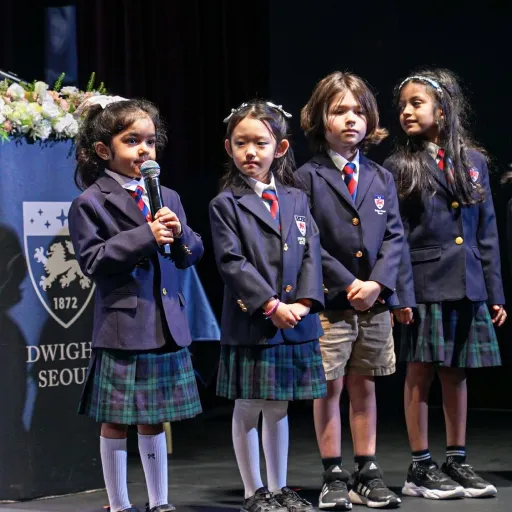
When parents explore South Korea’s top schools, Dwight School Seoul is a school that naturally enters the shortlist because of its clear model. The school publicly positions itself around three ideas that matter to families: full IB continuity, a warm community, and an intentionally personalised approach. For parents who want one school where a child can grow from early years to the Diploma Programme without changing educational philosophy, that continuity can be especially compelling. Dwight School Seoul also states that it is accepting 2026–27 applications, which makes early enquiry sensible for families still shaping their shortlists.
Parent Checklist: How to Decide if an IB School in Seoul Is the Right Fit
Use this simple framework:
- Your family may relocate internationally in the future
- Your child learns well through questioning, discussion, and projects
- You want strong English-medium or multilingual exposure
- You value university flexibility over a purely local pathway
- You want a school that combines rigour with individual support
- You are ready to begin the admissions process early
If most of those are true, an IB pathway is worth serious consideration.
Key Takeaways
- Demand for IB schools in Seoul is rising in 2026 because parents increasingly want internationally recognised, inquiry-led, future-facing education.
- The trend is supported by real market signals: Seoul’s IB expansion to 106 campuses, South Korea’s 110 IB World Schools, and strong global IB growth.
- Families comparing Seoul international schools with Korean schools in seoul should focus on fit, language environment, future mobility, and teaching philosophy.
- In 2026, early research matters. Schools are already publishing admissions cycles, and grade-level availability can tighten.
- Dwight Seoul is a strong option for families seeking full IB continuity, community, and a personalised approach to learning.
Conclusion
The rise in demand for IB admissions in Seoul is not happening by accident. It reflects a broader parental shift toward education that is portable, intellectually rich, and genuinely child-centred. In 2026, families are looking beyond simple labels and asking sharper questions about teaching, belonging, and long-term opportunity. That is exactly the right instinct. Whether you are newly arriving in Seoul or reconsidering your child’s next stage, the smartest next step is to begin early, compare thoughtfully, and choose a school whose educational philosophy feels as strong as its results.
FAQs
Why are IB schools in Seoul becoming more popular in 2026?
More parents want globally recognised education, inquiry-led teaching, and flexible university pathways, while Seoul and South Korea are also seeing wider IB adoption across the education system.
What makes Seoul international schools different from Korean schools in Seoul?
Many Seoul international schools offer international curricula, English-medium learning, and multicultural classrooms, whereas traditional Korean schools generally follow the national curriculum and local academic pathway.
Are all Seoul international schools IB schools?
No. Some international schools offer IB, while others follow different curricula such as American or British models.
Why do parents choose the IB over a traditional curriculum?
Parents are often drawn to the IB’s emphasis on critical thinking, writing, discussion, research, and international portability.
Are admissions to IB schools in Seoul competitive?
They can be. Schools publish structured application processes, and some note that certain grade levels may be full after re-enrolment.
When should families apply to IB schools in Seoul?
Earlier is better. Many families begin researching months before the academic year, especially if they need records, recommendations, or transition planning.
Do local Korean families also apply to IB schools in Seoul?
Increasingly, yes. The expansion of IB in Seoul’s wider education conversation suggests interest is broadening beyond expatriate-only demand.
What should parents look for in an IB school?
Look for programme continuity, strong pastoral care, clear admissions support, experienced teachers, and evidence that personalised learning is genuinely embedded.
What makes Dwight Seoul relevant in this conversation?
Dwight Seoul offers the full IB continuum, emphasises community and global vision, and highlights a personalised learning approach that many families actively seek.
Is the IB Diploma Programme recognised by universities?
Yes. The IB is an established global system, and Dwight Seoul positions its DP as a pre-university pathway designed to prepare students for higher education worldwide.