

Table of Contents
The IB Primary Years Programme is an inquiry-based curriculum framework for children aged 3–12. It connects subject knowledge through broad transdisciplinary themes while developing curiosity, communication, reflection and responsible action. Its suitability depends on how well a school balances student agency with explicit teaching, academic progression, appropriate structure and individual support.
Choosing a primary curriculum means considering not only what children learn but also how they learn. The IB Primary Years Programme (PYP) aims to develop students as active participants in their own learning rather than asking them simply to receive and reproduce information.
That does not mean children learn without structure or subject teaching. In a well-implemented PYP curriculum, teachers plan clear learning goals, assess progress and guide inquiry while helping children make connections across disciplines. Parents should examine how each school turns that framework into daily classroom practice.
What is the IB Primary Years Programme?
The IB Primary Years Programme is a curriculum framework for children aged 3–12. The International Baccalaureate describes it as inquiry-based, transdisciplinary and student-centred, with an emphasis on conceptual understanding and responsible action. The official IB programme overview explains that pupils are treated as partners in the learning process.
“Transdisciplinary” means that learning can extend cross traditional subject boundaries. A unit about access to water, for example, might involve scientific investigation, data handling, geographical understanding, persuasive writing and ethical discussion. This is an illustrative example; schools design their own programmes of inquiry within the IB framework while also meeting and any applicable local requirements.
The PYP is a curriculum rather than a fixed international syllabus. Consequently, two authorised IB World schools may organise content, languages, timetables and support differently. Parents comparing IB schools in Seoul should therefore look beyond the programme name and investigate how the PYP is implemented in practice at each school
How is the PYP curriculum organised?
The PYP curriculum connects knowledge, conceptual understanding , skills, personal attributes and action. Its three organising pillars are the learner, learning and teaching, and the learning community, according to the IB’s current curriculum framework.
Schools organise much of the curriculum through six transdisciplinary themes. These broad themes provide a framework for exploring significant local and global issues and enable students to revisit important concept with increasing depth and complexity as they progress through the programme.
|
Transdisciplinary theme |
Broad learning focus |
|
Who we are |
Identity, relationships, health, beliefs and what it means to be human |
|
Where we are in place and time |
Personal histories, journeys, discoveries and relationships between people and places |
|
How we express ourselves |
Ideas, feelings, culture, creativity and different forms of expression |
|
How the world works |
The natural world, scientific principles and human interaction with the environment |
|
How we organise ourselves |
Communities, systems, organisations, decision-making and economic activity |
|
Sharing the planet |
Rights, responsibilities, resources, living things and peaceful coexistence |
Individual subjects remain important. Language, mathematics, science, social studies, the arts, and personal, social and physical education contribute knowledge and disciplinary skills that children apply within and beyond units of inquiry.
At Dwight School Seoul, the published PYP page confirms that the programme serves Grades 1–5. Grade 1 pupils explore five units of inquiry, while Grades 2–5 explore six, connected to the six transdisciplinary themes above. Families should consult the school’s current PYP programme page because unit content and classroom arrangements may change between academic years.
What does inquiry-based learning look like?
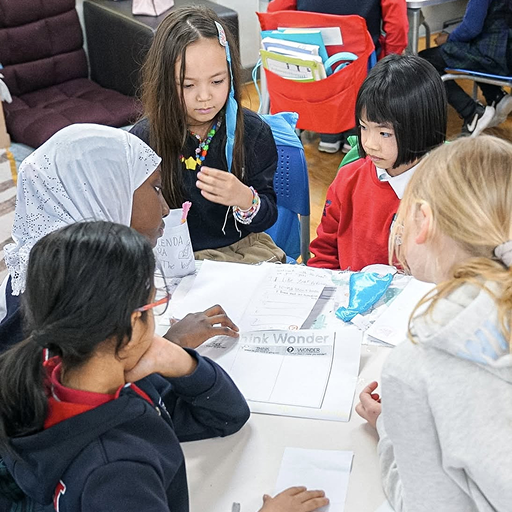
Inquiry-based learning begins with purposeful questions and investigation, but it is not the same as unstructured discovery. Teachers select appropriate suitable concepts, resources and learning experiences, teach essential knowledge and help pupils evaluate evidence and develop their understanding. A classroom inquiry may begin with a teacher’s prompt, a pupil’s observation or a shared problem. Children might then gather evidence, test explanations, discuss different interpretations, receive direct instruction where needed and reflect on how their understanding has developed.
The balance between pupil-led and teacher-guided inquiry should vary according to age, readiness and subject matter. Younger children generally need more modelling, carefully designed choices and predictable routines. Older primary pupils can gradually assume greater responsibility for planning research, selecting methods and communicating their findings.
The IB describes effective PYP learning as engaging, relevant, challenging and significant, supported by “authentic integrated assessment”. In plain language, assessment should be connected to meaningful learning and used to inform the next steps in teaching and learning not reserved only for an end-of-unit test. Read the IB’s learning and teaching guidance.
What is the IB Learner Profile?
The IB Learner Profile is a set of ten attributes intended to guide intellectual, personal and social development across all IB programmes. The attributes are inquirers, knowledgeable, thinkers, communicators, principled, open-minded, caring, risk-takers, balanced and reflective.
These are educational aims, not labels that every child is expected to demonstrate equally at all times. A thoughtful school uses them as shared language for growth. For example, “risk-taker” refers to approaching uncertainty with forethought and determination; it does not encourage unsafe behaviour.
The profile should also be visible in ordinary learning. A pupil might be a communicator when explaining a mathematical strategy, open-minded when reconsidering an interpretation, and reflective when identifying ways to improve a draft.
The IB states that the learner profile should permeate school life and involve the whole learning community, including parents and educators. Its attributes express the organisation’s conception of international-mindedness. See the IB’s guidance on the learner.
How does the PYP support the whole child?
The PYP is intended to connect academic learning with social, emotional and personal development. It encourages children to collaborate, exercise agency, consider different perspectives and take responsible action.
“Student agency” means having a meaningful voice, making appropriate choices and taking ownership of learning. It does not mean that pupils decide everything about what or how they study. Teachers remain responsible for curriculum quality, safeguarding, instruction and ensuring an appropriate level of challenge.
No curriculum can guarantee confidence, well-being or academic success. Outcomes depend on teaching quality, relationships, support, home circumstances and the individual child. Parents should therefore ask how a school identifies needs, communicates concerns and adapts teaching and learning, not assume that the PYP alone provide answers those questions.
How is progress assessed in the PYP curriculum?
PYP assessment is typically continuous and varied. Teachers may use observations, discussions, written work, performances, investigations, portfolios, self-assessment and more formal tasks to build a comprehensive understanding of each pupil’s progress.
Assessment can serve three distinct purposes:
- Assessment for learning helps teachers and pupils identify next steps in learning.
- Assessment as learning develops pupils’ ability to reflect on and take greater responsibility for their learning.
- Assessment of learning records what a pupil knows, understands or can do at a particular point in time.
Reporting formats vary because the IB provides a framework rather than a universal PYP report card. Parents should ask how a school monitors subject-specific attainment, which standards it uses, how frequently progress is reported and what happens when a child needs additional challenge or support.
What does the PYP look like at Dwight School Seoul?
Dwight School Seoul’s confirmed PYP programme for Grades 1–5 uses units of inquiry to connect six subject areas. The school describes personalised learning, community and global vision as its three educational pillars and says its PYP emphasises whole-child development, Approaches to Learning (ATL) and conceptual connections.
The school’s official IB record identifies it as an English-medium, co-educational day school authorised to offer the PYP, MYP and Diploma Programme(DP). Families can check the current status independently on the IB World School profile for Dwight School Seoul.
These programme features describe the overall educational framework and approach rather than guaranteeing particular outcomes for an individual pupil. Parents should ask how personalised learning is implemented within their child’s prospective grade, including the balance between explicit instruction and inquiry, language provision, learning support and communication with families.
How does the PYP prepare children for future learning?
The PYP can help children develop learning habits and skills that remain useful as their education becomes more specialised: asking productive questions, organising information, collaborating, communicating clearly and reflecting on feedback. It also introduces conceptual learning, encouraging pupils to explore transferable ideas and make connections rather than learning facts in isolation.
At Dwight School Seoul, pupils progress from the Grade 1–5 PYP into the school’s middle year program – officially the IB Middle Years Programme (MYP), in Grades 6–10. Both programmes emphasise inquiry and conceptual understanding, but the MYP introduces eight subject groups, more subject-specialist teaching and increasingly complex assessment.
An IB continuum can support continuity through shared language and educational aims, but progression is not automatically seamless for every pupil. Parents should ask how teachers exchange information and coordinate learning across divisions and how children are prepared for changes in organisation, workload and the level of independence expected of them.
Is the IB Primary Years Programme right for your child?
The PYP may suit children who enjoy asking questions, making connections and discussing ideas. It can also work well for pupils who prefer greater structure, provided the school balance inquiry with clear routines, explicit instruction, and carefully sequenced knowledge.
A practical framework for parents considering the PYP is to evaluate four key areas:
|
Decision area |
Evidence to seek |
|
Learning fit |
Examples of lessons, teacher guidance and how pupils exercise choice |
|
Academic clarity |
Written curriculum expectations and evidence of progression in literacy and mathematics |
|
Individual support |
How language, learning and wellbeing needs are identified and addressed |
|
School–family fit |
Reporting, parent communication, homework expectations and community culture |
A child who is quiet, cautious or new to English should not automatically be considered unsuitable for inquiry. The more useful question is how teachers create accessible ways for different pupils to participate.
What should parents look for during a school visit?
A strong PYP school should be able to demonstrate clearly how inquiry, subject knowledge and assessment work together to support student learning and progression. Classroom displays alone provide limited evidence; ask to see how learning progresses over time and understand how teachers use assessment and evidence of learning to make informed decisions about the next steps.
Look for:
- Pupils explaining what they are learning, not merely what activity they are completing
- Teachers using questions alongside explicit explanation and modelling
- Visible progression in reading, writing and mathematics
- Opportunities for reflection that go beyond decorative worksheets
- Meaningful connections between subjects rather than forced themes
- Age-appropriate choices within clear boundaries
- Evidence that assessment changes subsequent teaching
- Specific systems for language, learning and pastoral support
Questions parents should ask the school
- How do teachers balance pupil-led inquiry with direct instruction?
- How is progress in literacy and mathematics tracked across grades?
- What does personalised learning mean in daily classroom practice?
- How are multilingual learners supported in lessons?
- What support is available for learning or well-being needs?
- How are parents informed about attainment and next steps?
- Can you show how one concept develops across several grade levels?
- How do teachers distinguish productive struggle from a child needing intervention?
- What changes when pupils move from the PYP into the MYP?
- How do Seoul’s foreign-school eligibility requirements apply to our family?
Practical checklist for parents
Before comparing schools
- Identify how your child learns, communicates and responds to open-ended tasks.
- Separate curriculum preferences from practical needs such as location and transport.
- Confirm that each school is authorised for the programme it advertises.
During a visit
- Request a concrete example of a recent unit of inquiry.
- Ask how subject knowledge was taught and assessed within that unit.
- Discuss your child’s language, learning and well-being needs candidly.
- Compare support provision rather than relying on broad promises.
Before applying
- Review the current admissions requirements and grade-placement guidance.
- Confirm available places and the relevant academic-year calendar.
- Ask which information from the current school will help with placement.
- Recheck fees, transport and eligibility directly; these are time-sensitive.
Key takeaways
- The IB Primary Years Programme is a framework for children aged 3-12, not a single fixed syllabus.
- Inquiry combines pupil questions with deliberate teacher guidance and subject teaching.
- Six transdisciplinary themes help pupils connect learning across disciplines.
- The IB Learner Profile provides shared developmental aims, not guaranteed outcomes.
- Assessment should inform teaching as well as document attainment.
- Programme quality depends on implementation, support and fit with the individual child.
- Dwight Seoul currently offers its PYP in Grades 1-5, followed by the MYP in Grades 6-10.
Conclusion
The PYP offers young learners a structured way to explore significant ideas, connect subjects and take increasing responsibility for learning. Its value lies not in inquiry alone, but in the quality of teaching, curriculum progression, assessment and relationships supporting that inquiry.
For families considering Dwight School Seoul, a useful next step is to review the official PYP page and arrange a visit with one focused request: ask the school to show how a recent unit combined subject knowledge, pupil agency and assessment in your child’s prospective grade.
Frequently Asked Questions:
1. How are the six transdisciplinary themes explored throughout the PYP?
Schools develop a programme of inquiry containing age-appropriate units connected to the themes. The central ideas, content and learning experiences vary by school and grade.
2. What role do parents play in supporting PYP learning?
Parents can discuss children’s questions, encourage reading and reflection, and share relevant family or cultural perspectives. They do not need to recreate school enquiries or provide answers to every question.
3. How does the IB Learner Profile influence daily learning?
Teachers and pupils can use its attributes when setting goals, discussing behaviour, reflecting on work and considering different perspectives. Implementation varies between schools.
4. How is student progress assessed in the PYP?
Teachers use evidence gathered over time, including observations, conversations, written work, investigations and performances. Schools determine their reporting formats and may also use standardised measures.
5. How does the PYP prepare children for the MYP?
Both programmes emphasise concepts, inquiry, reflection and learning skills. The MYP adds greater subject specialisation, disciplinary assessment and organisational demands, so deliberate transition planning remains important.