


What Are ATL Skills in the IB Curriculum? A Simple, Practical Guide (with Examples)
In an age where facts are searchable in seconds, learning skills matter as much as academic knowledge. That’s exactly why the International Baccalaureate (IB) places so much emphasis on ATL skills, short for Approaches to Learning. Put simply: ATL skills teach students how to learn, not just what to learn.
At Dwight School Seoul, a fully authorised IB Continuum School offering ECD, PYP, MYP, and DP, this “how to learn” mindset aligns naturally with its mission to ignite the “spark of genius” in every child through personalised learning and global vision.
What Are ATL Skills in IB?
ATL skills in IB are a framework of transferable skills students build across subjects and grade levels. The IB describes ATL as grounded in the belief that learning how to learn is fundamental to student life in and out of school, and frames them in five broad categories.
Think of ATL as the “operating system” behind learning:
- Students plan, reflect, collaborate, research, communicate, and think critically, every day, in every class.
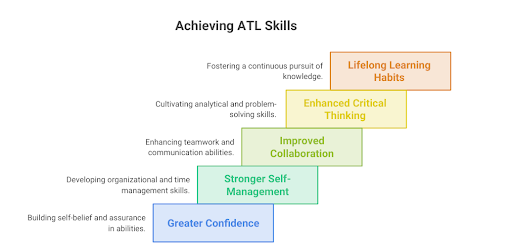
Approaches to Learning in the IB Curriculum
The International Baccalaureate (IB) integrates Approaches to Learning (ATL) skills into everyday classroom experiences rather than teaching them as a separate subject. This ensures that students continuously develop essential lifelong skills while engaging with academic content. In practice, teachers intentionally plan for both:
- Implicit ATL (skills embedded naturally in learning tasks)
Students develop ATL skills organically through classroom discussions, collaborative projects, inquiry activities, and everyday learning experiences.
- Explicit ATL (skills directly taught, practised, assessed, and reflected on)
Teachers intentionally introduce specific ATL skills, provide opportunities to practise them, assess students’ progress, and encourage regular reflection to support continuous improvement.
A key feature of the ATL framework is that students can monitor their own development as they progress from Novice → Learner → Practitioner → Expert. This gradual progression helps build confidence, independence, self-management, and lifelong self-regulation skills, enabling students to become active, reflective, and successful learners.
Statistical Insight: The research compared 560+ students from eight schools in three different countries, making it one of the largest international studies examining critical thinking outcomes in IB education. (Source: https://ibo.org/)
Key Categories of ATL IB Skills (with classroom examples)
The IB highlights five ATL skill categories.
| ATL Skill Category | What it looks like | Example in student-friendly terms |
| Thinking | Critical & creative thinking, transfer | “I can compare ideas and justify my opinion.” |
| Communication | Speaking, writing, presenting, media literacy | “I can explain my learning clearly to different audiences.” |
| Research | Information literacy, ethical use of sources | “I can find reliable sources and cite them responsibly.” |
| Self-management | Organization, time management, emotional regulation | “I can plan my week and stay calm under pressure.” |
| Social | Collaboration, empathy, conflict resolution | “I can work in a team and help others succeed.” |
How ATL Skills Support Student Success
ATL skills aren’t just “nice to have.” They directly support outcomes families care about:
- Better academic performance (without burnout)
Students learn how to study, plan, ask better questions, and reflect, so learning becomes more efficient and sustainable. - Confidence in real-world problem solving
IB learning is complex by design; ATL gives students the tools to navigate ambiguity and challenge. - Stronger collaboration and leadership
Group projects stop being chaotic when students explicitly learn collaboration skills, like giving feedback, delegating, and resolving conflict. - Learner agency (students who own their progress)
In the PYP, ATL supports students becoming more agentic and self-regulated, they set goals, make choices, and reflect on growth.

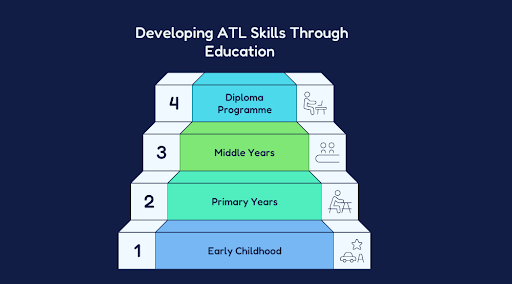
ATL Skills Across IB Programmes (ECD → PYP → MYP → DP)
ATL (Approaches to Learning) skills develop progressively throughout the IB Continuum, helping students build confidence, independence, and lifelong learning habits at every stage of their education.
- Early Childhood Division (ECD) & PYP Early Years: foundations through play, inquiry, communication, and social growth, Dwight Seoul’s ECD serves ages 2–6 and emphasises inquiry-based learning and purposeful play.
- PYP (Primary): students build routines for research, thinking, and reflection across transdisciplinary units.
- MYP (Middle Years): ATL becomes more structured; students use a shared language for skill development and reflection.
- DP (Diploma): ATL shows up in advanced research, academic writing, metacognition, and independence, essential for university readiness.
Statistical Insight: An international evaluation of the IB Middle Years Programme assessed 870 students from 21 schools across three countries and found that MYP students demonstrated higher levels of critical thinking than students following national curricula. (Source: https://ibo.org/)
What this can look like at Dwight School Seoul
Because Dwight Seoul emphasises personalised learning, students can develop ATL in ways that match their strengths, whether that’s becoming a confident speaker, a structured planner, or a curious researcher.
For families exploring early learning pathways, it’s also helpful to compare approaches. Here are the required anchor texts you can use to explore more:
Conclusion
So, what are ATL skills? They’re the IB’s practical answer to a modern challenge: knowledge changes fast, but learning how to learn lasts forever. ATL skills help students become capable, confident learners, ready for rigorous academics, teamwork, and life beyond school.
FAQs
1) What are ATL skills in IB?
ATL skills (Approaches to Learning) are transferable learning skills that help students learn how to learn across subjects, organised into thinking, communication, research, self-management, and social skills.
2) Why are ATL skills important?
They build student independence, stronger study habits, collaboration, and self-regulation, skills that improve academic success and lifelong learning.
3) Are ATL skills taught as a separate subject?
No. ATL is integrated into everyday teaching and learning, with both implicit and explicit instruction depending on the task and age level.
4) Do ATL skills apply across all IB programmes?
Yes, ATL develops across the IB continuum, becoming increasingly structured from early years into MYP and DP.
5) How does Dwight School Seoul support ATL skill development?
Dwight Seoul’s IB Continuum model and emphasis on personalised learning support ATL development throughout ECD, PYP, MYP, and DP.