

Why is the International Baccalaureate (IB) curriculum considered one of the best options for developing 21st-century skills in children?
You must have heard about the International Baccalaureate (IB) curriculum when you searched for a school for your kids. It is globally known for its thorough and demanding academic methodology. This program mainly focuses on building learners’ critical and creative thinking abilities. These 2 things are required for success in the 21st century.
This blog article addresses the value of these abilities within the context of the IB program. You will also see how IB curriculum schools help develop flexible and versatile learners.
The goal of the IB curriculum is to offer an integrated education that crosses standard academic limits. Its goal is to raise curious and informed minds. The students should be compassionate and driven young people.
The schools with such a curriculum emphasise self-directed learning and independent thought. The curriculum equips students with critical thinking and self-management skills. Both of them are essential for facing the diverse nature of our quickly changing global community.
Importance of Creativity in IB Curriculum Schools
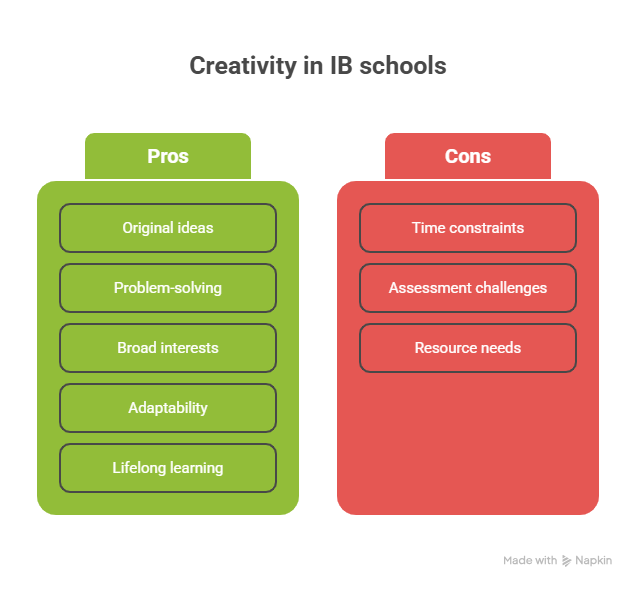
Creativity in the educational setting goes much beyond creative expression. It includes the capacity to come up with original ideas. Kids can think beyond the box and tackle problems in a different way. Institutions with the IB curriculum MYP foster creativity as a core cognitive ability, enabling students to create and adapt in academic and real-world contexts.
Being creative contributes to creating learners with broad interests. It motivates pupils to:
– Examine several approaches to solving challenging issues
– Using a variety of media to express themselves successfully
– Being adaptable and creative when faced with new situations
– Joining unconnected ideas to create original discoveries
Schools with the IB Middle Years Programme curriculum equip students with the creativity necessary for academic achievement. It is also for lifelong learning and flexibility to deal with a technologically changing community.
Statistic (South Korea context): According to the Organisation for Economic Co‑operation and Development (OECD) PISA 2022 creative thinking test, students in South Korea scored a mean of 38 out of 60, significantly above the OECD average of 33. OECD+1
And 90 % of South Korean students attained at least the baseline proficiency in creative thinking (Level 3 or higher) compared to 78 % OECD average. OECD+1
Importance of Critical Thinking in IB Curriculum Schools
The ability to evaluate data and consider many viewpoints is referred to as critical thinking in the educational setting. Doing such thinking helps you reach well-reasoned conclusions. It involves going against beliefs and seeing trends. You also learn to combine data from several sources to create well-researched findings.
Critical thinking abilities must be developed for:
– Developing the ability to solve problems
– Enhancing the decision-making process
– Fostering self-directed learning and research abilities
– Educating pupils about difficulties in the workplace and higher education.
Critical thinking is a life skill that helps students at IB curriculum schools. It allows them to pass through complex information conditions and make wise decisions with ease. Therefore, it is not just an academic activity as they also actively use it and contribute to society.

Do you know? : In South Korea, 82 % of students agreed or strongly agreed that they “can be creative in nearly any subject,” showing a high level of openness which correlates with both creative and critical thinking. OECD+1
Integration of Creativity and Critical Thinking in IB Curriculum Schools
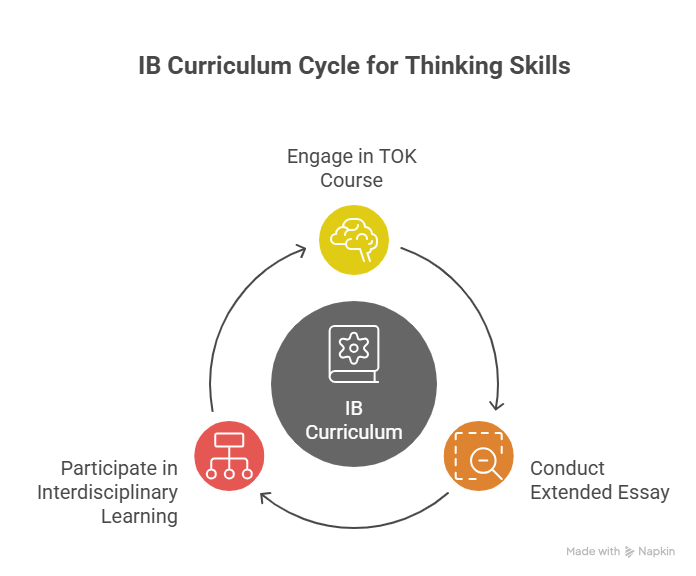
The IB curriculum structure is specially developed to foster the growth of critical thinking and creativity. This combination is seen throughout the program in a number of ways:
[1] Course on Theory of Knowledge (TOK): This is an essential component of the IB Diploma Program. This course invites students to consider the nature of knowledge in several fields. It pushes students to think critically and reassess their presumptions. This develops their capacity for both creative and critical thought.
[2] Extended Essay: Students can explore a topic of their choice in depth with this independent research assignment. The project encourages critical thinking in analysis and originality in approach.
[3] Interdisciplinary Learning: The IB program strongly emphasises links between many topic areas. It inspires students to think critically and creatively across fields to address challenging, real-world problems.
Conclusion
It is impossible to exaggerate the importance of creativity and critical thinking in view of a complex and interconnected global society. With its inclusive approach to teaching, IB program schools are leading the way. It puts students on the path to meaningful professions as well as purposeful lives of service to society.